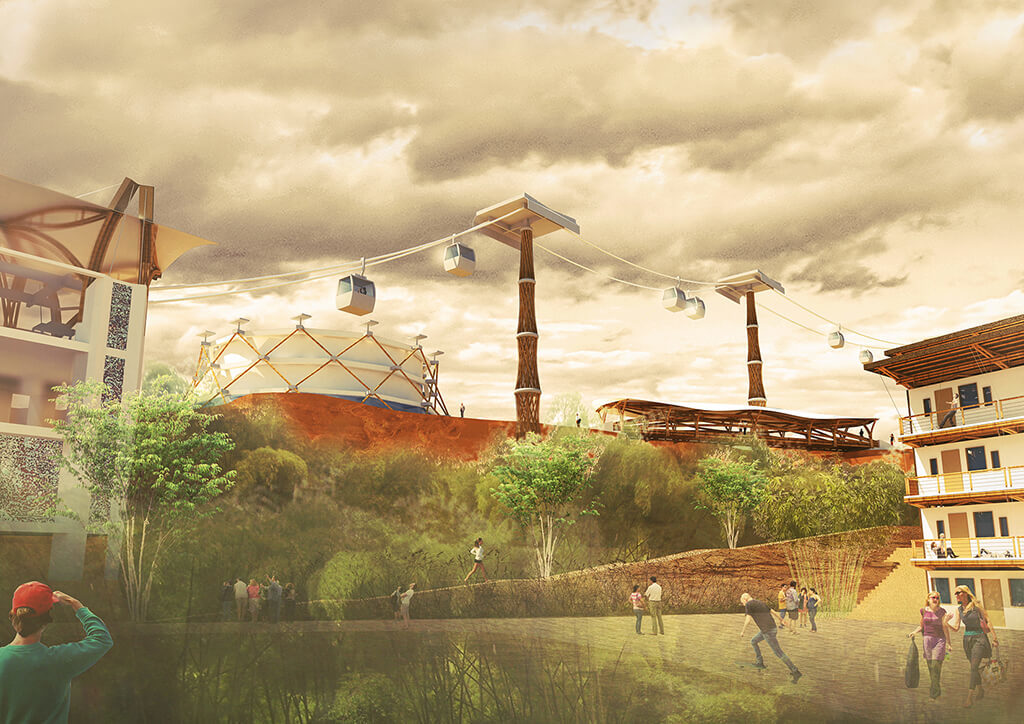
Figure 1: Visualization of one of the proposed public spaces.
 Bambusa Espinosa
Bambusa Espinosa
Bambusa Espinosa
Key words
1) Demographic Growth;
2) Urban Density and Compactness;
3) Sustainable Urban Design;
4) Transit-Oriented Urban Developments;
5) Participatory and Inclusive Land Readjustment.
Summary
‘BambUrbanism’ means an alternative way of approaching the urban sphere from the perspective of materiality. Two-thirds of the world’s most populated cities are located near sources of bamboo; likewise, two-thirds of the world’s most populated countries have bamboo within their borders. Bamboo is one of the most widely available and renewable materials, with characteristics that make it suitable even for large structures. Colombia is the most advanced country in the use of bamboo as a construction material and in its research. Medellín was awarded as the most innovative city in the world.
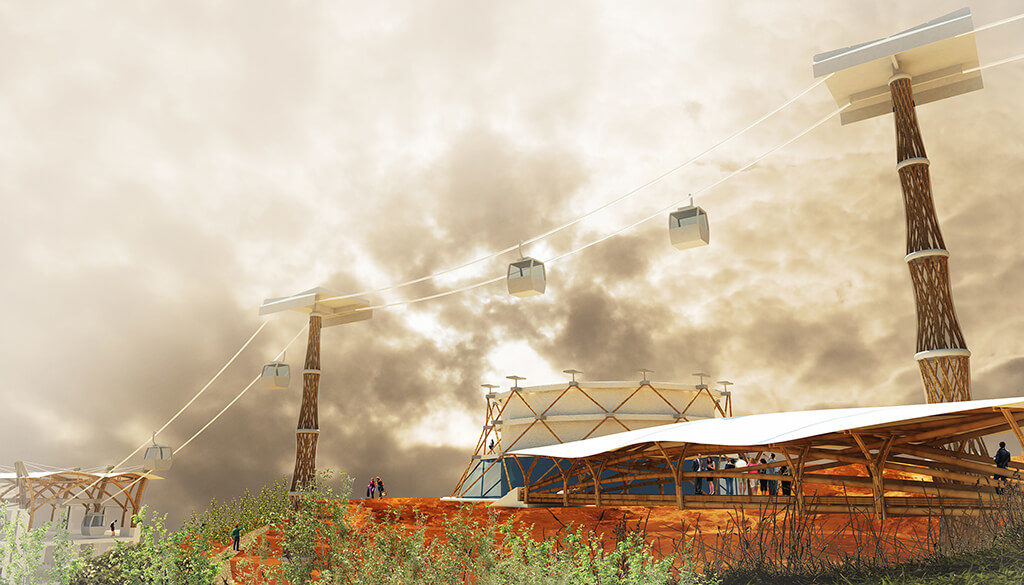
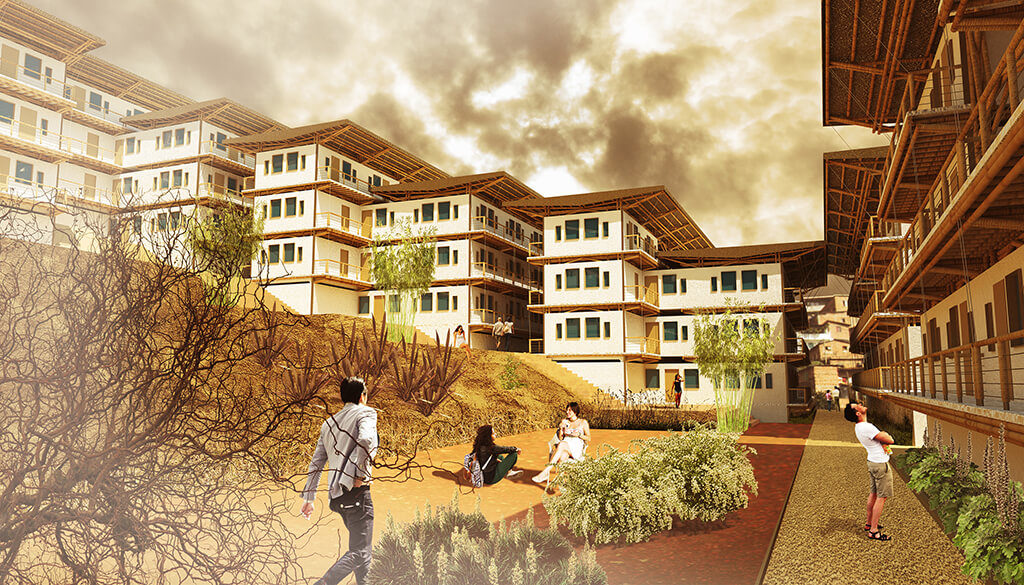
The present proposal brings together the concepts of ‘transit-oriented urban development’ and ‘participatory and inclusive land readjustment’ in order to relocate in situ very low-quality housing while also providing new units for demographic growth, as well as bamboo construction systems for the execution of pedestrian walkways, the support structures of the public cable car, community buildings, and housing.
Introduction
Sustainability in the urban context is more crucial than ever before due to the accelerated growth of the urban population and the strong impact that cities have on the planet. Cities by themselves are not a sustainable way of life, but they are the most efficient way to bring large groups of people together when they are properly planned and managed. Moreover, cities are living organisms that represent an inexorable phenomenon. This article focuses on the material dimension of city-making.
Among all the materials used in construction, there is one that stands out due to its potential environmental, economic, and social benefits: bamboo. Bamboo is abundantly available in those areas where the highest rates of urbanization are occurring; it is one of the fastest-growing plants; and it can be worked using labor-based technologies instead of relying on heavy machinery.
After a global-scale overview focused on the relationship between the natural growth zones of bamboo and the location of the world’s most populated countries and cities, we will delve into the Colombian context, presenting an initial design proposal at the national scale that addresses the structuring of this growing industry in order to maximize and distribute the potentially generable income from the use of this highly renewable and accessible resource.
The city of Medellín, in Colombia, was recognized in 2013 as the most innovative city in the world, after having long been known as one of the most dangerous and violent. Over the past decade, political commitment and citizen participation have come together with the aim of improving living conditions for residents, starting with the poorest. What has made this transformation in Medellín possible is mainly:
Transit-oriented urban development projects in the areas where low-income families live;
Micro-credit programs for small businesses; and
Social housing carried out in parallel with high-quality urban design.
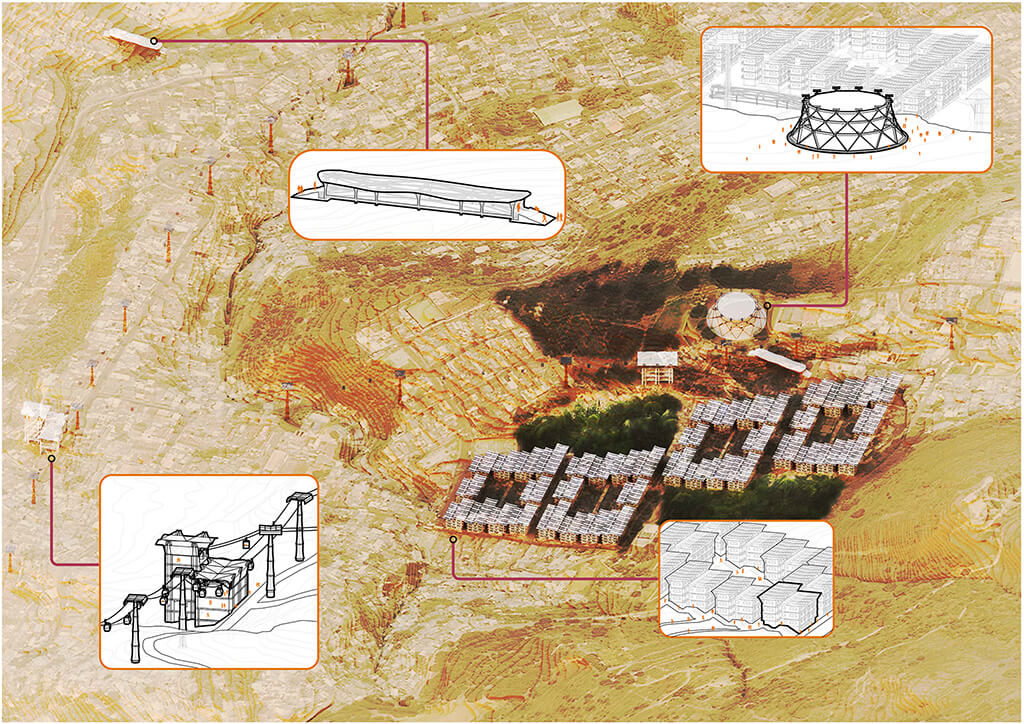
Inequality and unemployment remain challenges that Medellín must still confront. This design proposal identifies, at the urban scale, extensions of the current public transportation system with the intention of covering most of the city with the public transit network while generating new urban centralities around the transit stations. A local-scale example is provided to show how these areas are renewed through so-called ‘urban devices’ and through the design of urban street typologies. The structures in the design proposal are based on bamboo, and the urban strategy is centered on a bamboo plantation for recreational, educational, and leisure purposes, serving as the main public space.
Presentation Sections
Global Scale
The current globalized society as a project site / Location of the most populated cities / Key role played by cities / Most populated countries / Countries with the highest demographic growth rate.
Regional Scale
Colombia: At the forefront of bamboo construction / ‘Technological Matrix’ / Bamboo products for the construction market.
Urban Scale
Medellín: The most innovative city / Urban-scale analysis and proposal.
Local Scale
Water Cycle System in the proposal / Urban devices: Mobility / Urban devices: Community / Urban devices: Housing.
Detail Scale
Typology of public spaces / Detail plan / Housing system.
–
All rights reserved.
© J. E. Espinosa Benito, 2.024